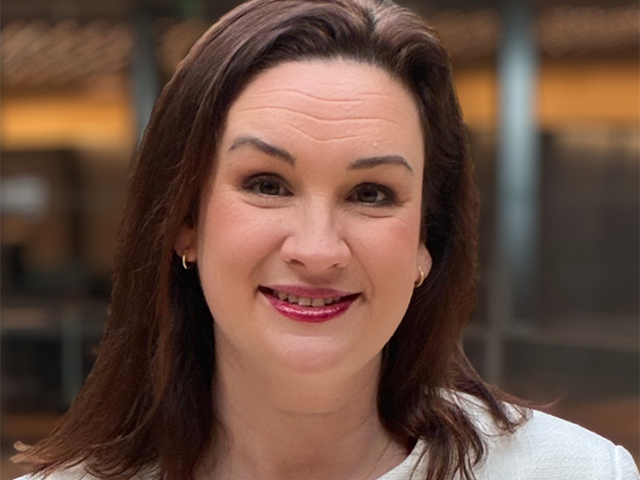
Kat, please tell us a little about your career background and day to day responsibilities at Bloomberg.
A little over a year ago I took on the role of Global Head of Electronic FX Trading at Bloomberg. This was my first foray into the world of FX, having spent the majority of my career in Fixed Income, most recently having led Emerging Markets Trading Product for Bloomberg.
In this new role, my focus is on continuing to invest in and evolve the FXGO platform. This means expanding liquidity, broadening instrument coverage, and delivering more automated, innovative, and scalable workflows.
A big part of that is staying very close to our clients. As market structure evolves, be it with regulation, electronification, multi-asset trading strategies, or the growing role of data, we need to make sure we’re building solutions that genuinely move the needle for them.
This is very much a team effort. We have an exceptionally strong global team in FXGO across engineering, product, and sales, with deep expertise across both markets and technology.
What really stands out is the team’s ability to take complex client requirements and translate them into practical solutions.
How do you see the competitive landscape and demand for electronic FX trading platforms and services evolving and where do you think Bloomberg is best positioned to take advantage of the opportunities this will present?
Demand for electronic FX trading continues to grow as clients seek greater efficiency, transparency, and interoperability, but also more flexibility in how they execute.
Workflows are becoming more complex, and clients increasingly expect trading platforms to support everything from high-touch trading through to fully automated, API-driven execution and negotiation. Clients are looking for solutions that can simplify and standardise processes, and that’s an area where we continue to invest heavily.
Bloomberg is well positioned against this backdrop thanks to the combination of deep liquidity and a broad and diverse set of clients.

Colleen McFadden, FICC Implementations Lead for Americas – Jacob Wylie, FXGO Lead for Liquidity Relationships for Americas and EMEA – Leo Tong, FXGO Data Product –
Josh Cater, FXGO Americas Sales Lead – Oleg Shevelenko, FXGO Product Head of Pricing and Execution – Francesco Tonin, FXGO Options Product
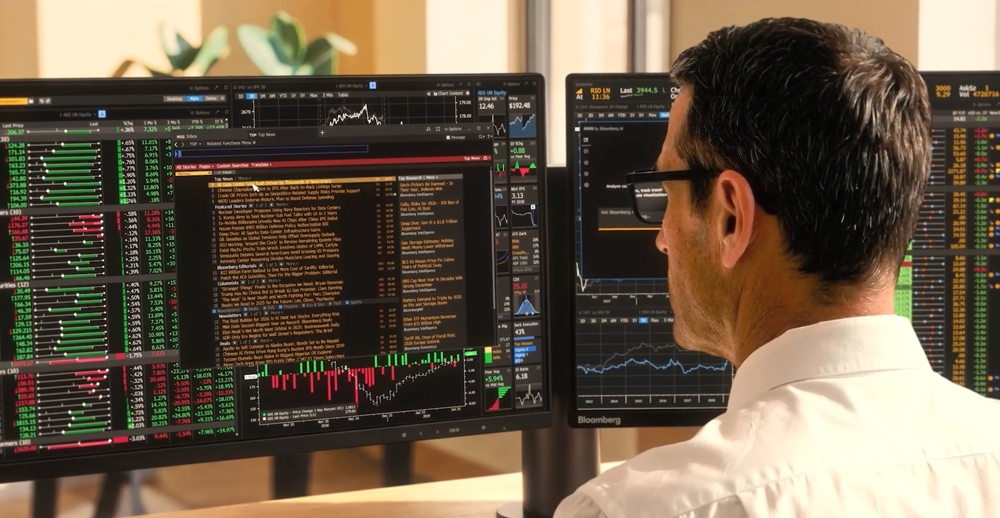
While many trading platforms focus solely on the “execution” of a trade, Bloomberg’s FXGO allows clients to combine data, news, communication, and execution in a single suite of solutions.

Paula Fry, Global Head of FICC Liquidity Relationships
There’s no need to switch between multiple apps or screens. When market-moving news breaks, they can see the headline, get market colour from their counterparty via IB, and execute a trade seamlessly. By bringing the entire workflow into a single suite of solutions, they reduce the “latency of thought,” minimise errors, and act before the market moves away from them. This is a key differentiator for us.
“What really stands out is our team’s ability to take complex client requirements and translate them into practical solutions”
FXGO gives FX trading clients access to one of the largest communities of market professionals and users in the world. What advantages do they get in being part of this community?
One of the biggest advantages of the FXGO community is its reach: with over 20,000 users across 140 countries, and a diverse mix of participants from asset managers, real money and hedge funds to central banks and regional institutions, the FXGO platform provides a compelling level of counterparty reach.
Clients benefit from direct access to liquidity from more than 1,200 counterparties and 6,000 dealing desks, which diversifies execution risk and drives competitive pricing through broader market participation.
Another advantage of FXGO is the inclusion of local and regional liquidity.
Because more than half of the traded volume is still quoted manually by sales traders via the Terminal, FXGO helps bridge the gap between high-speed electronic markets and the “high-touch” requirements of some trades, particularly in emerging markets. This distinction is key for firms in frontier or emerging markets where trades are often more complex and require a human conversation. For many of these local firms, Bloomberg is a technology partner that supports access to the global markets.


Over the last year FXGO has seen trillion-dollar trading days. What were some of the highlights of this activity and where have you seen particularly strong engagement from different types of clients?
The jump we’ve seen to trillion-dollar days isn’t just about market volatility; it’s a result of a structural shift toward electronic execution. A highlight for us has been the 40% year-to-date growth in algorithmic trading volumes. This isn’t just Spot FX anymore either; NDF algo usage alone is up almost 60%.
Another standout is FX Options, where volumes have surged over 40% year-over-year. With the introduction of Python-based APIs, firms can now structure and trade complex derivatives with the same speed as traditional FX. Hedge funds, in particular, are increasingly leveraging programmatic execution, API connectivity, and data-driven analysis to refine execution quality and optimise outcomes, driving more than 20% year-over-year increase in volumes from this segment.
A key driver of this is our momentum in APAC, where electronic volumes are up over 25% year-over-year, largely driven by NDFs and FX options. The region continues to outpace other areas and has been particularly strong among asset managers and regional banks in Singapore, Hong Kong, Tokyo, Jakarta, and Manila.
How is Bloomberg’s electronic FX offering evolving to support the shift from voice to fully automated FX workflows across the trade lifecycle?
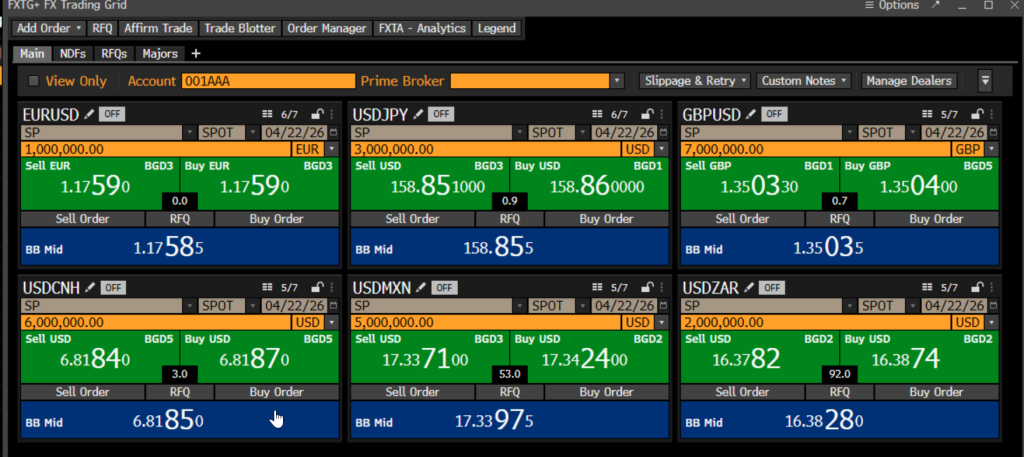
We’re focused on connecting the entire FX trade lifecycle into a more automated and integrated workflow, while also providing clients with flexibility and transparency. That starts with pre-trade analytics, optimisation and netting, moves through to execution via RFQ, streaming and algos, and extends into post-trade reporting and data delivery for enhanced performance benchmarking.
In the area of pre-trade price discovery, we recently introduced MYQ, a price monitoring tool designed to improve price discovery by using Bloomberg’s NLP to take fragmented pricing communications across multiple IB chats and display them in a centralized format.
Over the past year, we’ve continued to invest heavily in tools such as APIs, bulk execution and rules-based automation so that clients can adapt their approach to FX execution in a manner of different ways to suit their preferences and systems, and in doing so reduce manual overheads.
To increase scale, we’ve enhanced our execution management capabilities by introducing more advanced auto-routing, basket trading and batch processing, so clients can handle large volumes of orders in a more systematic way.
Where full automation is desired, clients can use our Rule Builder Automation tool kit to define execution parameters or they can integrate using Direct Order Routing via APIs, enabling fully automated workflows directly from client infrastructure.
Alongside this, we continue to strengthen areas like deposits, where we already have a well-established electronic workflow with strong integration into client systems and straight-through-processing.
Importantly, we integrate with a wide range of third-party OMS and EMS platforms – including Bloomberg’s own – helping clients to connect FX seamlessly into their broader trading workflow.

What changes are you seeing in the mix of participants on your platform and how is that shaping your product roadmap?
We’re seeing a continued broadening of the client base, both in participant type and in workflow depth. Growth is particularly strong among asset managers focused on scaling execution across portfolios, as well as hedge funds. At the same time, engagement is increasing from emerging market participants and from clients trading a wider range of instruments, including NDFs, options, and swaps.
We’ve developed a tailored roadmap for asset managers in particular to address the complexities of the full trade lifecycle. By introducing advanced netting, order optimisation, and flexible automation controls, we’re helping firms reduce ticket volumes and operational friction.
We’ve also enhanced our algorithmic trading suite with the basket trading functionality, enabling clients to execute groups of trades more efficiently while maintaining control over execution outcomes.
We’ve already touched upon the investment in low-touch and automated workflows but it’s worth emphasising how this is supported by data which is surfaced in other contexts, such as pre-trade intelligence, with integrated TCA, Bloomberg’s transaction cost analytics solution, and “what-if” netting tools to inform routing decisions before execution.
Hedge funds also continue to be a growing client segment. To support them, we’ve expanded our API suite, including our most recent release in FX options. We’ve also enhanced our bulk trading tools to address the complexities of trading via credit intermediaries, enabling best execution across varying post-trade fee structures from their prime brokers.
By expanding our EMS capabilities and reinvesting in core engineering, we’re ensuring the FXGO platform remains a reliable and efficient venue for FX trading, regardless of market conditions. By delivering consistency and transparency across all client types, we give users the workflow flexibility they need to stay ahead in increasingly electronic markets.

We’ve developed a tailored roadmap for asset managers in particular to address the complexities of the full trade lifecycle
Demand for algorithmic FX trading is growing. As firms become increasingly confident in algos how is Bloomberg tailoring roadmaps for different types of clients to help meet their particular algorithmic execution demands?
Where we are observing the fastest increase of FX execution algo adoption is in the asset manager and hedge fund client base. Asset managers often prioritise scalability and governance, so the basket algo trading, bulk routing, and optimisation capabilities we’ve focused on developing are intended to support their high volumes of algo orders efficiently.
Hedge funds, particularly systematic and macro strategies, tend to focus on speed and integration, so features like pre-configured algo orders and API-driven workflows are key. We also continue to expand algo coverage across instruments such as NDFs and swaps. By working closely with clients and liquidity providers, we ensure our roadmap reflects evolving execution needs.

How are you adapting your FX trading products for an environment where more buy-side and corporate clients want to manage FX as an integrated part of multi-asset portfolios rather than a standalone activity?
We see a continued shift toward multi-asset trading and Bloomberg is well-positioned to deliver a fully integrated, cross-asset workflow spanning order management, execution, post-trade processing, and analytics. Our EMS supports FX, fixed income, equities and all the major derivatives of these products, enabling clients to manage orders across asset classes within a single, consistent suite of solutions.
This is underpinned by deep integration with our cross-asset trading platforms, allowing for seamless order routing and execution across liquidity pools. Increasingly, we’re observing interest in multi-asset trading workflows. For example, we recently launched the ability to invoke an FX trade linked to an Emerging Market local government bond transaction.

Workflows are becoming more complex, and clients increasingly expect trading platforms to support everything from high-touch trading through to fully automated, API-driven execution.
How are regulatory and best-execution requirements in different jurisdictions influencing and shaping the design of your electronic FX products and data tools?
Regulatory compliance isn’t a separate task; it is a core feature of the trading workflow. Our design philosophy is to make compliance a natural part of the workflow, rather than something that sits alongside it. Regulation is a key driver of how we design our products, particularly around transparency, data structure and reporting.
A major priority is our trade lifecycle delivery infrastructure. We now provide daily files of event and quote data to both banks and the buy-side, which are used directly in their internal surveillance and monitoring systems. We’ve also embedded support for Unified Product Identifiers (UPI) and Report Tracking Numbers (RTN), ensuring that Dodd-Frank and EMIR reporting is handled automatically via our post-trade APIs.
In emerging markets, we are actively shaping market structure through solutions like BMatch. In jurisdictions like Nigeria, Sri Lanka, and Iceland, we’ve worked with central banks to move local currency auctions into a regulated, electronic environment.
This hasn’t just improved transparency; it has contributed to currency stability by providing a reliable, auditable price discovery mechanism. Whether it’s through NDF-specific algorithms or granular audit trails, our goal is to give participants the confidence to trade electronically while meeting the strictest jurisdictional requirements.

What are your goals and strategic priorities going to be as the electronic FX market structure continues to change over the next few years?
We see technology as a key driver of change in evolving the trading process, and we’re positioning ourselves at the forefront of that evolution. We’re continuously optimising FXGO to unify liquidity access, decision-support tools, next-generation execution, and analytics into a single, integrated workflow.
As part of this, we are revamping and consolidating our tools for streaming and request-for-stream into a cohesive framework to enhance consistency, scalability, and control across workflows. We are also developing the next generation of counterparty selection tools to support more informed, data-driven routing decisions.
In parallel, we are enhancing our bulk trading capabilities to efficiently handle large volumes of orders, improving scalability while maintaining precision and alignment with best execution requirements.
We are investing in data and benchmark-driven insights to drive more efficient, informed execution through automation. At the same time, we are making FXGO more modular and accessible via programmatic APIs for order entry, liquidity access, account management, and audit trail retrieval.
Together, these initiatives are designed to deliver a more intelligent, scalable, and integrated trading environment, enabling clients from a diverse user base to adapt to evolving market structure, improve execution outcomes, and operate with greater efficiency and control in increasingly electronic markets.

Our initiatives are designed to deliver a more intelligent, scalable, and integrated trading environment.