


Why did FinQor set out to build 1FXPD and what is it designed to do?
1FXPD was created to resolve FX process inefficiencies by delivering a single, enterprise-wide, real-time platform that unifies pricing, hedging, settlement, and monitoring across internal systems and external venues. Built by practitioners for practitioners, it functions as intelligent middleware — enabling price discovery, risk transfer, pre- and post-trade decision making, and end-to-end post-trade automation at scale with 24x7x365 availability.
Rather than competing with an institution’s existing infrastructure, 1FXPD occupies a central orchestration role, bridging line-of-business systems with liquidity channels and complementing chosen pricing engines, STP tools, core banking, and payment gateways to deliver a streamlined, coordinated FX workflow across internal and external ecosystems.
How does 1FXPD bridge the gap between pricing, risk, payments, and balances?
1FXPD aggregates liquidity from multiple venues, applies adaptive risk-transfer logic, and routes pricing requests and trades — supporting real-time or cached pricing, automated hedging, and post-trade settlement including general ledger updates. The result is continuous alignment of pricing, hedge execution, and balance reporting across the organisation.
Decisioning logic spans a wide array of attributes — time of day, day of week, segment, geography, volatility, volume, direction, regulation, and more — to determine the lifecycle of every order or request. The platform integrates with multiple pricing engines, manages deal-by-deal and aggregated netted hedging via a suite of algorithms to the most suitable venue, and analyses post-trade activity to refine settlement and payment costs.
What advantages does a rules-based intelligent decision engine bring for regulatory, compliance, and trade outcomes pre- and post-trade?
A rules-based intelligent decision engine codifies configurable controls across pricing, hedging, and settlement to align with regulatory and internal policies. It provides pre-trade validation, automates risk-coverage decisions, and enforces market- and jurisdiction-specific limits — all with auditable, 24/7 decisioning and sub-microsecond performance.
FinQor’s dedicated Regulatory Compliance Layer enforces programmable controls, delivering fast and consistent automated responses across large trade volumes. This enhances throughput while reducing operational and regulatory risk — helping firms avoid fines, sanctions, and processing bottlenecks.
What are the core functional components of 1FXPD?
1FXPD is a fully customisable toolkit, with core output benefits for each deployment:
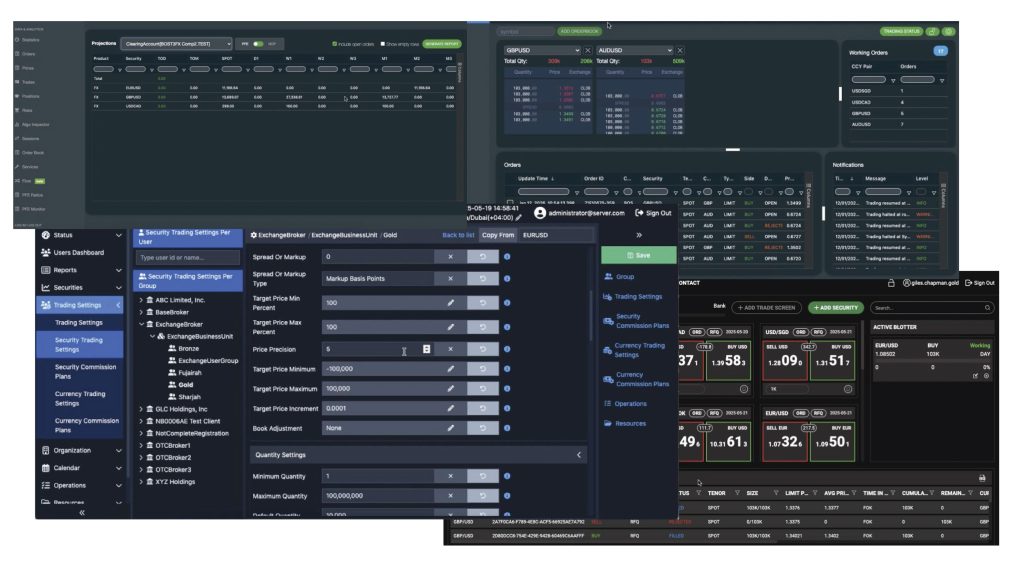
- Dynamic Pricing — Real-time liquidity aggregation from multiple sources with sub-10ms refresh rates, supporting highly configurable pricing across currency, volume, segment, location, risk, credit, time of day, and day of week. This supports faster, more precise pricing decisions across diverse market conditions and client profiles enterprise wide.
- Risk Transfer Nexus — Automated hedging workflows powered by adaptive algorithms across an extensive range of currency pairs, reducing manual intervention while improving hedging effectiveness and overall risk management throughput across an entire system landscape of an organization.
- STP Orchestration & Cost Savings — Bi-directional API integration with 45+ core banking and payment systems and 140+ pricing and liquidity sources enables full straight-through processing. Transaction netting and workflow aggregation drive post-trade cost reductions of 40–72%+ across brokerage, settlement, and payment processing. A rules-driven engine and Regulatory Compliance Layer ensure policy-aligned, automated responses at scale.
- Economies of Scale — End-to-end workflow automation manages vast data throughput, enabling scalable price discovery, execution, and hedging without human intervention – delivering consistent operational efficiency as volumes grow.
- Multi-Source, Multi-Venue Pricing Framework — Robust post-trade handling including aggregation, routing, and margining ensures resilient pricing operations across singular and bulk deal coverage ensuring that regardless of segment, system, currency and/or channel an entire organizations FX and payment business is catered for.
Please outline the features offered by the platform for monitoring and control of risk and system management.
The platform provides a comprehensive suite of tools supporting continuous risk oversight, operational control, and regulatory compliance:
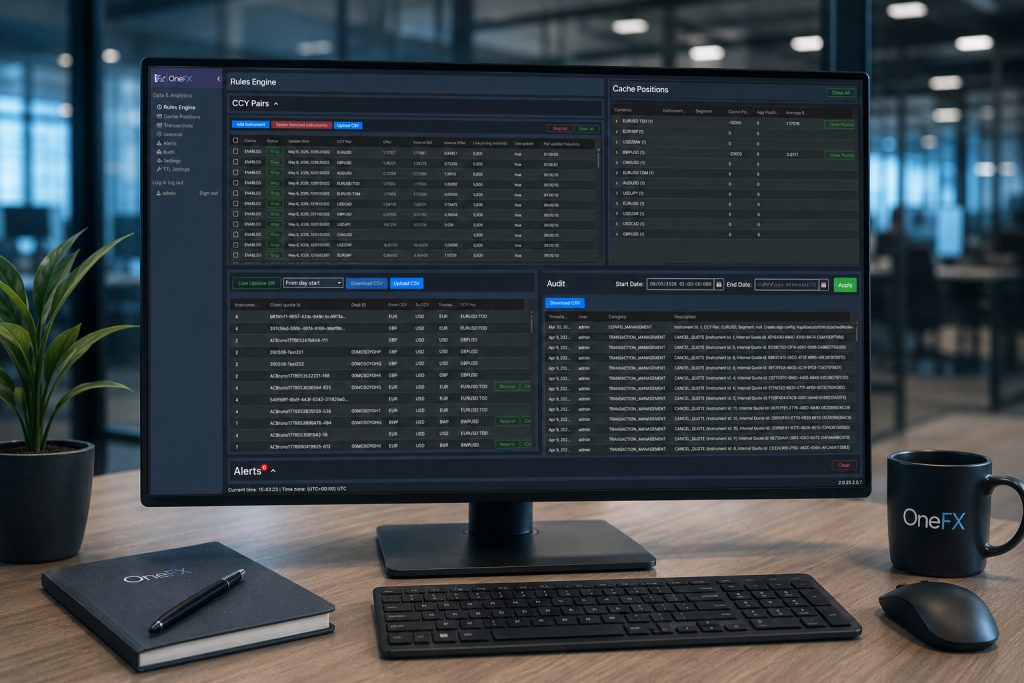
- 24×7 Pricing Monitoring — Continuous pricing surveillance with support for live and cached operational modes, with seamless switching to maintain pricing integrity during connectivity disruption or system stress.
- Real-Time Position & Risk Management — Real-time position tracking with full risk transfer visibility pre- and post-aggregation at point of execution. Dynamic cache refresh controls reflect current risk appetite, with both granular and portfolio-wide risk views available.
- Alerts, Dashboards & Exception Handling — Intuitive dashboards providing at-a-glance visibility into system health and risk events, with a configurable alert framework covering exception handling, trade rejections, and system-level events for rapid identification and escalation of anomalies.
- Intraday & End-of-Day Risk Routing — Automated risk routing into hedging venues and General Ledgers on both an intraday and end-of-day basis, with configurable volume-based flush rules to align workflows with internal risk policies.
- Regulatory Controls & Audit Trails — Integrated compliance controls embedded directly into deal workflows, with comprehensive audit trails capturing all system and transactional events to support a complete and defensible regulatory record.
Together, these features deliver an end-to-end risk and system management framework that supports real-time decision-making, operational resilience, and regulatory readiness — enabling firms to confidently manage risk across the full trade lifecycle.
How does the architecture enable horizontal expansion into adjacent verticals (digital assets settlements, multi-currency ledgers)?
The platform’s containerised microservices architecture and modular API layers make horizontal expansion seamless — new pricing engines, asset classes, and market pipelines can be added, swapped, or run in parallel without rewriting core logic.
Designed to be asset-class agnostic, 1FXPD is already battle-tested across FX, Stablecoins, Crypto, Equities, Futures, Options, and Fixed Income, with built-in interoperability across multiple pricing sources and ledger systems.
This has recently extended into on- and off-ramping capabilities within the DeFi Real World Assets (RWA) space — a central focus of the platform’s R&D roadmap — delivering infrastructure that actively shapes tomorrow’s financial landscape, not just today’s.
Where does the platform’s unique value lie for firms seeking sophisticated APIs to interlink end-to-end digital FX journeys?
1FXPD delivers a single integration layer that harmonises pricing, risk, and settlement workflows across internal systems and external venues through a rich, language-agnostic API suite — REST, WebSockets, and more. By automating price discovery and risk transfer, it eliminates the complexity and cost of managing multiple disparate APIs and rate sheets, giving firms faster time-to-value, deeper operational visibility, and scalable, governable FX operations.
How would you summarise the key benefits of implementing 1FXPD?
Implementing 1FXPD delivers measurable benefits across pricing, operations, and risk management. Firms typically achieve substantial cost reductions of between 40–72% in end-to-end pricing and settlement costs, driven by intelligent aggregation and straight-through processing — a compelling return on investment by any measure. Beyond cost savings, the platform provides dynamic real-time or cached pricing with true 24×7 availability, ensuring consistent price integrity even during periods of heightened market volatility when gaps in coverage are most damaging and when markets are closed.
Operationally, end-to-end automation significantly reduces manual intervention across the enterprise, improving settlement accuracy and freeing teams to focus on higher-value activity. From a liquidity and risk perspective, dynamic rule-based hedging and tiered pricing give firms far greater control over liquidity management and pricing strategy — enabling more responsive, governed, and precise execution.
Finally, firms benefit from faster onboarding and considerably lower operational disruption compared with traditional multi-vendor implementations, meaning the path to value is both shorter and smoother.
Taken together, these capabilities position 1FXPD as a transformative platform for firms seeking to modernise and future-proof their FX operations.
How have you gone about speeding up deployment of the platform and minimising any disruption on integrating it?
FinQor’s containerised microservices approach enables rapid production deployment — typically under 90 days — with a straightforward integration pathway into 45+ core banking, payment, and pricing systems, and over 140 digital & Pricing exchanges. Incremental, phased onboarding of lines of business, multi-source pricing, and validator rules minimises disruption to legacy systems, while robust DR, backup, and monitoring capabilities deliver a clear, measurable path to full automation.
Across many parts of the world institutional access to direct and competitive market pricing is inconsistent with many financial institutions, particularly in emerging markets, lacking real-time pricing infrastructure. How much of an opportunity does this present for FinQor?
This represents a large and underserved opportunity. 1FXPD can standardise, automate, and accelerate price discovery, hedging, and settlement across cross-border FX — addressing critical bottlenecks in MENA, Africa, and beyond. With real-time pricing, automated risk transfer, and 24×7 operations, FinQor enables institutions to improve margins, reduce settlement delays, and enhance cross-border liquidity management.
Currently FinQor focuses on regional markets, particularly MENA and Africa. What plans do you have to expand beyond these?
FinQor has established strong traction across the GCC and Africa, building meaningful relationships and earning the trust of sizeable financial institutions. This foundation is now fuelling a deliberate expansion into the wider MENA region, broader African markets, Southern Asia, and select Western markets — accelerated by a growing partner ecosystem that opens new geographies and regulatory environments efficiently.
Complementing this growth, we are relaunching 1FXRM — our second core product — extending our offering into trading-oriented capabilities including exchange-style tools, Smart Order Routing, OMS/EMS middleware, and digital asset on/off ramping.
Our primary focus, however, remains on deepening our presence across the GCC and Africa, where FinQor’s impact is already being felt and the immediate opportunity is greatest.
How firms can learn more about FinQor’s offerings?
Firms interested in FinQor’s FX middleware solutions can connect via www.finqor.com, LinkedIn, or through ADGM to discuss products, use cases, and API-led integration strategies. FinQor offers a single integration point for all FX workflows, supported by case studies and client references.