

The arrival of high-frequency trading firms in FX options may suggest that the market is entering another latency race. Speed will remain important, but the principal bottleneck in options is different from spot FX, equities and other products whose workflows are more easily standardised.
In spot FX, equities and other more standardised markets, firms gained an edge by processing information faster, updating prices and executing orders more quickly. In FX options, the decision itself is more complex. Traders must first judge whether to take exposure through an instrument whose value and risk depend on strike, expiry, the volatility surface, liquidity and changing market conditions. They must then interpret that exposure through models whose outputs depend on assumptions.
The next phase of electronification will therefore not be defined solely by faster execution. It will be defined by reducing decision latency, the time required to turn data, analytics and judgement into a defensible course of action. The first phase moved information, prices and orders faster. The next will help market participants reason better and decide faster.
What the first wave of electronification solved
The electronification of spot FX and equities addressed a relatively clear set of frictions. Prices that had once been distributed through voice channels could be streamed electronically. Liquidity could be aggregated across venues. Orders could be routed, matched and executed automatically. Firms could respond to market information at far greater speed and scale.
This transformed the economics of trading. Automated pricing engines allowed market makers to update quotes continuously. Execution algorithms reduced the cost and inconsistency of manual order handling. Greater competition and transparency contributed to tighter spreads, while electronic records reduced operational risk and made activity easier to monitor.
The competitive advantage increasingly lay in shortening the path to receiving information. Firms invested heavily in market data, network infrastructure and execution technology to remove delay. In many cases, the relevant decision rules could be defined in advance and applied repeatedly as market conditions changed.
This did not eliminate judgement from spot FX or equities. Traders still had to decide when to provide liquidity, how much risk to warehouse and when market conditions required intervention. But more of the workflow could be standardised, encoded and automated.
The first wave of electronification was therefore highly effective where the central challenge was moving prices, information and orders faster. FX options present an additional problem. Their price and risk depend on many interacting variables, so the analysis cannot be reduced to a simple predefined sequence. Traders must reason across models, assumptions and changing market conditions before deciding how to act.
Why FX options are different
FX options are harder to electronify because the decision cannot be reduced to a single price or signal. The value and risk of an option depend on several dynamic variables at once, and those variables interact.
A trader must assess the spot and forward market, the level and shape of the volatility surface, the strike and expiry of the option, expected liquidity and the cost of hedging. The same trade may also look different depending on inventory, client flow, credit usage, margin consumption and the assumptions embedded in the pricing model.
These inputs do not sit neatly in one place. Some are drawn from live market data, others from pricing and risk systems, research, web, and internal chats. Some can be measured directly, others require interpretation. All of them can change while the decision is being made.
This creates a very different workflow from one in which a pre-defined rule can be applied repeatedly. A trader may begin with a hypothesis on volatility, test how that hypothesis behaves across different market regimes, and then revise the hypothesis or abandon the idea altogether. The method of analysis changes as the problem becomes better understood.
That is one reason why FX options have retained more manual and expert-led workflows than spot. The bottleneck is not only access to information. It is the time required to bring fragmented inputs together, choose the right analysis and convert the result into a defensible trading decision.
In practice, this creates several forms of friction. Bespoke analysis takes time. Relevant information sits across disconnected systems. The volume of market data can exceed what any individual can process. And the assumptions behind a decision are often difficult to inspect or reproduce afterwards.
In FX options, the challenge is therefore not simply to execute a known decision faster. It is to reach a sufficiently good decision before the market changes.
What reasoning means in trading
Reasoning in capital markets is the process of combining evidence, calculations, assumptions and constraints to reach a decision.
It begins with information. Live and historical market data, news and research, pricing models, risk analytics, positions and internal context. Reasoning, however, is not simply the accumulation of more inputs. It involves determining which inputs matter, how to turn those inputs into evidence, which analytical methods to apply, and how to interpret the resulting outputs.
This is where modern AI represents a meaningful change. Its value does not lie only in processing more information or performing calculations more quickly. It lies in the ability to adapt the method of analysis to the problem, selecting relevant evidence, choosing appropriate tools, testing alternatives and refining the conclusion as the analysis develops.
Reasoning capability can sit within the large language model itself, particularly in newer reasoning models designed to decompose and solve complex problems. It can also be created through orchestration, where an LLM coordinates market data, analytical tools, pricing models and other systems through a multi-step process. The distinction is important and deserves separate treatment. Here, the focus is the market consequence rather than the model architecture.
What matters here is that reasoning AI differs from a conventional analytical pipeline. A fixed system follows a predefined sequence of rules. A reasoning system can change the sequence, revisit assumptions and pursue a different line of analysis when the evidence points elsewhere.
For FX options, this creates the possibility of supporting parts of the decision process that have historically depended on manual analysis and expert judgement. The opportunity is not to replace the trader, but to help the trader move from fragmented information to a better-supported decision with greater speed.
The electronification of reasoning
The first era of electronification accelerated the movement of data, prices and orders. The next can accelerate the analytical process that sits between information and action.
That process is slowed by four recurring sources of friction. First, bespoke analysis takes time to produce, particularly when traders or quants must manually code, test and run scenarios. Second, the relevant inputs are fragmented across market data, pricing systems, research, and internal communications. Third, the volume of information creates cognitive overload, making it impossible for a human to identify what matters most to the decision with confidence. Fourth, the assumptions and analysis behind a decision are often difficult to inspect or reproduce afterwards.
Reasoning AI can address each of these constraints within a single workflow. A trader could ask a complex market question and have the system gather the relevant data, call pricing and risk models, incorporate research and internal context, test alternative hypotheses and present the resulting trade-offs.
This is different from automating a fixed sequence of tasks. The system can adapt the analysis as the problem develops, moving from interpretation to quantitative testing, revisiting assumptions and selecting different tools where required.
The result is a shorter path from question to conclusion, fewer breaks between systems and less time spent assembling analysis manually. It also gives the trader a clearer basis on which to review the evidence and exercise judgement.
The objective is not autonomous decision-making for its own sake. It is to compress the distance between a complex market question and a defensible course of action.
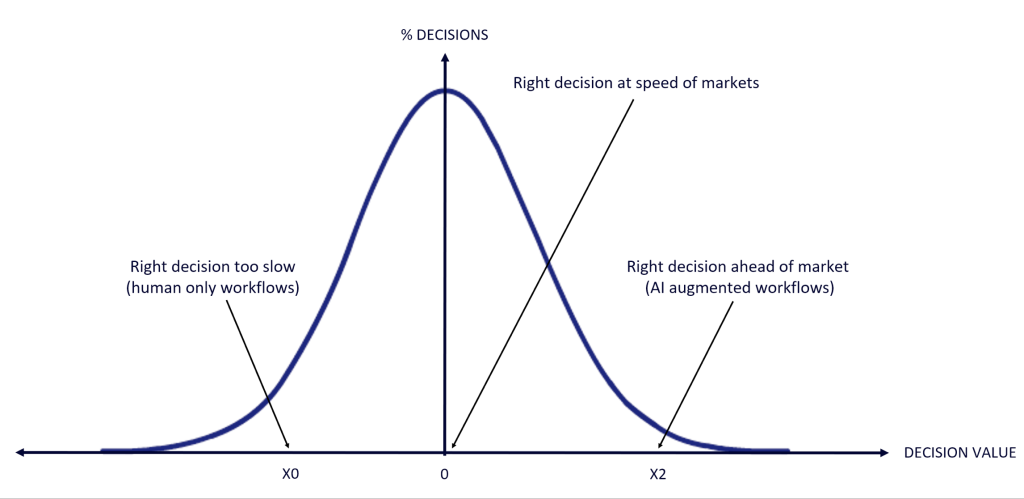
The value of a good decision decays with time.
More analysis can improve confidence, but markets continue to move while that analysis is being produced. Volatility shifts, liquidity changes, new information becomes available, and opportunities disappear.
A correct conclusion reached too late may therefore have little value. The relevant question is not only whether a decision is right, but whether it is reached while the opportunity still exists.
As the graph illustrates, decision quality cannot be considered independently of decision speed. Additional analysis may improve the quality of a conclusion, but beyond a certain point the value of that improvement is offset by the time taken to produce it. The objective is not to maximise analytical completeness. It is to reach the best available conclusion while the decision can still influence the outcome.
This becomes harder as the volume of information increases. Markets now generate more data than any individual can process. As Nobel laureate Herbert Simon observed, “A wealth of information creates a poverty of attention”. The constraint is increasingly not access to information, but the ability to identify what matters and act on it in time.
Reasoning AI can create value by prioritising relevant evidence, accelerating analysis and shortening the path from information to action. Competitive advantage will increasingly belong to firms that can make better decisions at the scale and pace required by the market.
Faster reasoning must remain trusted
Speed without control is not enough.
Traders need to understand what information, assumptions and calculations support a conclusion. AI-generated analysis should be reviewable and reproducible, rather than accepted simply because it sounds persuasive.
AI-generated analysis should leave behind an inspectable record of the data used, assumptions made, tools called, calculations performed and conclusions reached. Numerical analysis should be reproducible, while qualitative reasoning should be traceable to its supporting evidence.
The analysis must also fit within existing risk, governance and control frameworks. Human responsibility remains central, particularly where decisions have material trading or risk consequences.
The next phase of electronification must therefore combine depth and speed with transparency and control. AI should strengthen experienced judgement, not obscure or replace it.
From faster execution to faster judgement
Spot electronification compressed the time required to distribute prices and execute orders. FX options demand a broader and more adaptive analytical process before execution can occur.
Reasoning AI can shorten the path from complexity to conviction by helping traders interpret evidence, test ideas and reach defensible decisions faster.
The next phase of FX options electronification will not be defined only by how quickly firms can act. It will be defined by how quickly they can understand enough to act well.