


FX HedgePool is an award-winning matching engine for the mid-market execution of FX swaps. The firm’s platform has transformed the foreign exchange market with the breakthrough unbundling of liquidity from credit – unlocking vast potential for passive hedgers to provide liquidity to their peers, while banks optimize their balance sheets. We asked Jay Moore, CEO and Founder of the company, to tell us more about the benefits of his platform and why the time was right to launch it.
Jay, FX HedgePool has been live going on 2 years now and is clearly gaining momentum in the market. Can you talk a bit about what is behind the excitement for what you’re doing?
Our vision from the start was not to build products that enrich the rich, but rather to strip costs from the market and ultimately put money back in the pockets of everyday investors.
When we began the FX HedgePool journey, we set out to fix what we saw as a glaring problem with the FX swaps market. Market structure was forcing inefficiencies between the buy-side and sell-side that introduced layers of cost that eventually are paid for through the investment products that we all, the investing public, own in our retirement accounts and personal investment portfolios. We aim to change that.
As career finance professionals, friends and family often ask us questions like, “What makes one manager or fund better than another when deciding who to trust with our investments?” Truth is, for the longest time we didn’t know!
When we really think about it however, it’s clear that the most successful money managers in the world are the ones who look under every stone for innovative ways to evolve the market and find savings to pass along to their investors. Managers who find new ways to reduce costs, streamline workflows, and optimize their resources are the ones able to pass along those efficiencies in the form of better performance and/or more economical products to their investors.
These are the firms that are embracing FX HedgePool.

The most successful money managers in the world are the ones who look under every stone
for innovative ways to evolve the market and find savings to pass along to their investors.
Please can you explain how your firm is enabling a more efficient marketplace, how that impacts investors and how it works?
Just as Uber matches drivers to riders and AirBNB matches guests with accommodations, FX HedgePool uses technology to match buys and sells among buy-side institutions with mutually offsetting trading requirements. This eliminates layers of costs and risk in the process.
The current FX market structure relies on the relationship between credit and liquidity for the buy-side to execute FX trades with the sell-side. This dependency has created a bottleneck, where pricing can only come from banks with whom a buy-side firm has credit lines available. The best price may be from some other party, bank or otherwise, that you may not have a credit relationship with, and therefore is unavailable to you as a buy-side trader.
Banks, on the other hand, offer the balance sheet necessary from a credit perspective to book and settle the FX trades against a buy-side firm/fund, while also having the burden of being relied upon for pricing in all market conditions. Unfortunately, this relationship limits the flow of both liquidity and credit across all participants in the market.
At FX HedgePool, we’ve modernized the institutional foreign exchange market by 1) creating the technology that allows liquidity to flow anonymously within a community of the world’s largest buy-side institutions, while 2) enabling banks to remain at the center of the credit relationship to sustainably monetize their balance sheets by providing credit-as-a-service.
This new market structure eliminates layers of unnecessary costs to the buy-side, putting money back in the pockets of the investing public while allowing the sell-side to replace high-risk and volatile trading revenues with reliable and transparent fees. A win/win/win for all parties – most importantly, for us as investors.
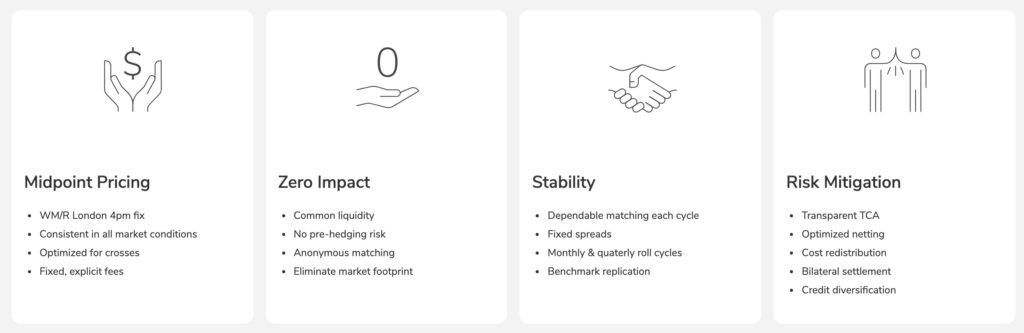
The key advantages of FX HedgePool.
What does the buy-side consider to be the greatest benefits of FX HedgePool?
The FX HedgePool model, and peer-to-peer in general, aims to address several pain points for the swaps market, including spread volatility, tracking error, operational risk and of course, market impact.
When we started out, our initial focus was on spread savings. Funnily enough however, as we spoke with more and more large buy-side institutions, many claimed that swaps pricing was at or near “mid”. We asked ourselves how this was possible while banks’ FX businesses remain highly profitable in the process. But, there really can only be one of two explanations.
The first is that if one client is getting mid, then another must be paying a disproportionately high spread to balance things out and ensure that the banks are net profitable. From the investing public’s perspective, this doesn’t sit well, as one way or another it’s money out of the pockets of investors.
Second, given the reliable nature of passive rolls (swaps), perhaps a bank knows the position is coming and in preparation for the trade, they begin to build inventory to ensure a fair price to their client at the time of execution. Unfortunately, while this helps banks manage their risk (which they should be able to do), pre-hedging the position creates market impact. While the client may get a mid-price at the time of execution and look great on their TCA reports, the bank was able to buy low and sell high, which means that again, investors lose as a poorer price leads to a worse performance in their funds.
It’s difficult to argue with the benefits of substituting risky trades from an opaque, expensive, and inefficient market with safe and reliable matched trades on a highly transparent, dependable, and automated technology platform. Peer-to-peer makes this possible.
Does FX HedgePool’s liquidity benefit the sell-side?
Absolutely. In the FX market, there are two essential elements of a trade. The first is pricing and the second is credit and settlement. As mentioned, to provide and accept a price, a credit relationship must exist between the firms. FX HedgePool has broken this long-standing dependency.
Under the FX HedgePool model, although liquidity is now directly accessible between peers, the sell-side remains central for the credit and settlement of the trade. By transforming credit into a service, we’ve created an entirely new way for banks to dependably monetize their balance sheet, while offering a valuable service to the client relationships that they’ve worked so hard to cultivate.
Additionally, liquidity and credit provision don’t always go hand-in-hand. There are numerous global banks with high quality credit ratings and appetite for credit exposure but are specialized in certain currency pairs and unable to compete in others. Alternatively, some banks may be highly competitive in pricing, but have limited balance sheets or capacity for credit. This has created a highly concentrated market, preventing the diversification needed to properly achieve best execution.
Separating liquidity from credit allows both elements of the execution to be optimized, creating a better balance in the market on the whole equation.
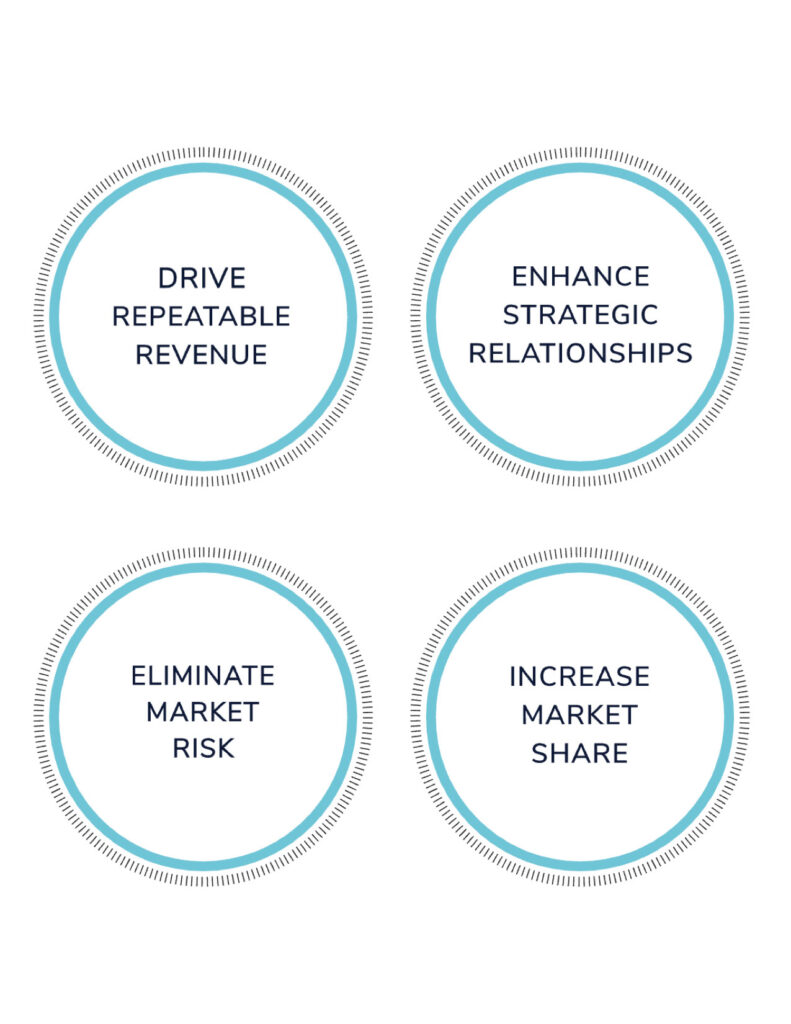
A growing panel of banks are getting these benefits from FX HedgePool
Why now?
Innovation in the swaps market has lagged as the broader FX market has evolved towards electronification over the past ten years. I’d argue that this is largely due to the market structure dependencies I’ve talked a lot about and the complexities of credit.
At the same time, growth of swaps has outpaced all other aspects of the market. This is mainly a result of dramatic increases in passive investing and the corresponding demand for programmatic FX hedging. With this growing demand comes an increased need for liquidity, but perhaps more importantly, the need for automation and scale. Without automation, firms on both sides of the market face higher levels of operational risk, credit consumption and resource constraints. All these forces contribute to greater costs and inefficiencies, which are passed on to the end investors in some form or another.
With the innovative technology of FX HedgePool, we have created a unique marketplace for passive hedgers where over $2.5 trillion of volume has been matched to date – proving that large demand can be satisfied off market. That’s $2.5 trillion that was never exposed to market impact or the juggle between price and credit. It’s also the volume that was executed without needing highly experienced traders to negotiate or distract their time and attention from more strategic trading requirements. We believe we’re well on our way towards a better exchange that ensures we all receive the greatest returns on our investments.