
In previous contributions to e-Forex, we discussed why dark mid-matching has become increasingly relevant for FX execution. The original argument was simple: If participants can seek offsetting interest in a neutral, anonymous environment, at an independent pre-formed mid-rate, they can reduce market impact and improve execution outcomes without contributing to the noise of the lit market.
That argument has not changed. What has changed is the scale of the opportunity.

The act of seeking liquidity ITSELF is a signal which is problematic for
larger orders, less liquid currency pairs and algo execution strategies
Midpools
Not all midpools are the same and most do not address a structural problem in FX execution: The act of seeking liquidity itself becomes a signal. This is particularly problematic for larger orders, less liquid currency pairs and algo execution strategies designed to work over time. A well-designed midpool offers an alternative: a place where genuine offsetting interest can meet without advertising to the wider market.
This is where the Siege FX MidPool stands out from other mid-pools. It was built around three key ingredients: An independent mid-rate, a dark order pool and a central counterparty model that ensures all participants remain anonymous even after matching. These features matter because if orders are not visible, they cannot be used as a signal; if the pool is not price-forming; activity in the pool does not influence the next price and if participation remains anonymous post-trade; users can interact without revealing their identity, strategy or urgency to others.
Together, these design choices created the conditions for Siege FX to help its participants to move risk without moving markets. Today the MidPool matched volumes have grown exponentially, and the system has developed into a highly functioning execution tool handling billions of orders and matches for the largest market participants in FX across all time zones.
Next stage of the journey
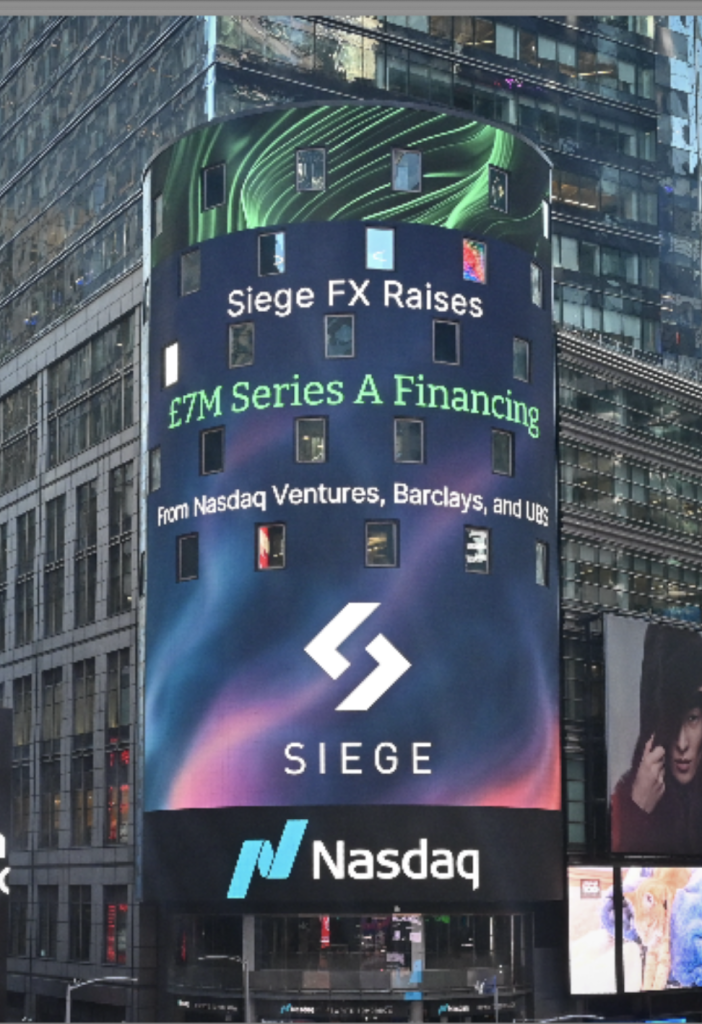
The completion of Siege’s Series A investment round marked an important milestone. Strategic investment from Nasdaq Ventures, UBS and Barclays provides not only capital, but also external validation. Our strategic investors recognise that improving execution quality is about building an infrastructure that allows participants to trade more efficiently, with better controls and with less unnecessary interactions. As the company embarks on the next stage of its journey, the support and participation of these strategic investors will accelerate Siege’s ability to deploy additional innovative solutions in FX and financial markets more broadly.
The appointment of Andy Ross as Chairman is also significant in this context. Andy brings deep experience in financial markets workflow, which is highly relevant to the next phase of Siege’s development. The future of execution technology will not be defined only by matching logic or venue design. It will be defined by how effectively solutions can fit into the real workflows of banks, asset managers, corporates and other institutional participants. This means understanding how orders originate, how traders make decisions, how systems connect, how credit is handled, and how post-trade processes need to function. For a platform such as Siege, this workflow perspective is paramount.
Expanding the model
Siege is now expanding its model beyond traditional Spot FX and Precious Metals have been an important step in that direction. The launch of XAU and XAG trading through the MidPool framework and the surprisingly quick growth of volume and matching success, shows that the principles behind dark mid-matching are not limited to spot FX. Wherever participants face spread cost, information leakage or market-impact risk, there is value in a neutral mechanism which allows them to anonymously seek offsetting mid-matching liquidity.
The importance of restricted markets for global investors, banks and corporates has grown significantly in recent years. In these non-deliverable markets, execution quality matters enormously as liquidity can be fragmented, spreads are meaningful, and the cost of information leakage is high. Many of the same factors which make dark mid-matching valuable in deliverable currencies are present, and often amplified, with NDFs.
As Spot FX proved the model, and Precious Metals showed that it can extend beyond traditional currency pairs, NDFs present a major opportunity for Siege to apply the same market-impact reduction principles, and this is why Non-Deliverable Forwards are the natural next step.
The broader direction is clear. FX execution is becoming more automated, more data-driven and more workflow-dependent. Participants want better outcomes, but they also want solutions that fit with the systems and relationships they already rely on. They need transparency of rules, strong controls, operational reliability and confidence that their information is protected.
For Siege, the guiding principle remains unchanged: “Move Risk, Not Markets”. The next chapter is about applying that principle more broadly across the FX ecosystem — from Spot FX to Precious Metals and NDFs — while preserving the features that made the model valuable from the outset: neutrality, anonymity, and no information leakage.