

For business owners landing a new international client or contract, or working cross-border on a regular basis, there’s a lot to think about. The recent turn in geopolitics towards trade barriers, tariffs and Trump has caused countless headaches for business owners globally. On top of this, outbreaks of conflict in Ukraine and more recently the Strait of Hormuz have put further pressure on well-established supply chains.
Business owners looking beyond their own shores already face a wide range of challenges, from navigating different languages, legal systems and regulatory frameworks, so a decade of political drama is the last thing any business needs.
This is where we find ourselves, however, so the question now becomes: how to smooth out some of the bumps in the business road?
Facilitating international payments is often lumped in with general administration but this is precisely the wrong way around, and they should be central to international business strategy. After all, if payments go wrong, there is no business. Not only this, a good payments strategy can help mitigate some of the geopolitical and economic headwinds currently facing global trade.
Not so special FX
The political turbulence seen over 2026 has sent FX markets – and consequently the price of transactions – cartwheeling. In turn, this can impact cash flow and even the strength of commercial relationships.
For SMEs in particular – which unlike corporate counterparts don’t have teams of FX and currency analysts – issues with payment costs, delays or reliability can have a much wider impact, potentially affecting their credibility, reputation and the strength of relationships with overseas suppliers.
Even small movements in exchange rates can affect costs. For example, a US supplier invoice can cost a UK business more if the pound weakens against the dollar before it is paid. This is becoming a more important issue as international trade becomes part of day-to-day operations for more businesses. HMRC data shows that 362,992 businesses moved goods across UK borders in 2025, up 2% on the previous year, while the number of businesses importing goods rose by 4%. As more businesses manage international transactions as part of their day-to-day operations, the systems supporting those payments need to keep pace.
All of which means that, for entrepreneurs looking to embark on international business, having payment processes that are flexible, transparent and able to respond when circumstances change is increasingly critical.
Paying Attention to Payments
Alongside getting caught on the wrong side of FX movements, the payment process itself can create an administrative burden for businesses, adding unnecessary time and complexity to international trade.
As companies become more digitally connected, many parts of international trade have become faster and easier to manage. Businesses can now communicate with suppliers instantly, track shipments in real time and manage orders digitally, yet moving money across borders is not always as straightforward.
Payments can still pass through several banks before reaching a supplier, particularly where the banks involved do not have a direct relationship. The Bank of England’s latest cross-border payments guidance highlights the additional cost and time involved in international transactions, noting that some cross-border payments can take several days and cost up to ten-times more than a domestic payment.
This can make it harder to know exactly how much a payment will cost or when the money will arrive – neither of which is particularly helpful when trying to plan ahead. While a shipment can be tracked from a warehouse to a customer’s door, the journey of a cross-border payment can be far less transparent once it enters the banking system. The Bank of England identifies transparency as one of the areas where cross-border payments continue to lag behind domestic payments, with some legacy systems also lacking real-time monitoring capabilities.
When there is limited visibility over a payment’s progress, the work does not necessarily end once the money has been sent. Finance teams may still need to check whether funds have left the account, confirm that the correct amount has arrived or check transactions across different systems. None of these tasks is particularly complicated, but collectively they can turn a straightforward payment into something of an administrative project. When international payments become a regular part of operations, these seemingly minor checks can quickly add up, becoming a surprisingly effective way of keeping a finance team busy.
This clear disconnect between how businesses now operate and how cross-border payments are still processed will only scale as a problem if not properly addressed.

Navigating the unpredictable trading environment
If the traditional payment model already creates some unpredictability, the wider trading environment is not exactly helping.
2026 has already seen some big FX swings, oil price spikes and conflicts everywhere from Iran to Venezuela. And while everybody would hope for calmer waters ahead, there’s thus far little sign of it. The UK has a new Prime Minister, political change is reshaping Europe, and rising radical movements are adding to global economic uncertainty.
It can sometimes feel as though we are living through a period of profound change, with businesses having to make decisions against a backdrop that can shift considerably from one month to the next.
President Trump’s tariffs and the threat of further changes to US trade policy, ongoing conflict in the Middle East and resulting energy price movements have all added another layer of uncertainty for businesses trading internationally. Currency markets can also react quickly to political and economic developments, meaning the cost of a transaction can change even after commercial terms have been agreed.
The one thing businesses can probably rely on is having something new to keep an eye on, which is already being felt across the UK. According to the ONS, in late April 2026, 38% of businesses with 10 or more employees said they were concerned about international conflict affecting their supply chains over the following year, up 28% from December 2025. This research also found that 39% of exporting businesses reported higher exporting costs in March 2026 than a year earlier, the highest proportion since September 2023.
Those concerns are understandable, given that the effects of geopolitical disruption are already showing up in the way businesses are paid. Research from Allianz Trade found that, following the escalation of conflict in the Middle East, the share of companies being paid within 30 days fell from 10% to 7%, while the proportion waiting more than 70 days rose from 15% to 24%. With 43% of businesses expecting payment terms to deteriorate further, the effects of geopolitical disruption are becoming increasingly tangible, reaching businesses not just through higher costs, but through when they actually receive their money – which is unlikely to do much for a business’s reputation as a reliable trading partner.
This makes flexibility all the more important, not only to prepare for and manage individual disruptions, but to respond as conditions continue to change. Payment infrastructure needs to support that flexibility, whether that means managing different currencies, adjusting payment timings or having greater visibility over the cost of a transaction, particularly when the market has other ideas about how predictable it is going to be.
Businesses cannot control whether tariffs change, a shipping route is disrupted or a currency moves unexpectedly, but they can control how prepared they are to respond when those things happen. The goal should be to make the payment process manageable enough to help navigate the uncertainty they cannot control.

Why this is a bigger issue for SMEs
For SMEs, these challenges can become particularly significant as international trade becomes a more frequent part of day-to-day business. A smaller business may be dealing with overseas suppliers, customers and different currencies without the specialist infrastructure that a larger organisation can put behind its international payments.
The Department for Business and Trade’s latest research into UK SME exporters found that international trade remains heavily reliant on paper-based processes, with businesses facing delays, additional costs and uncertainty as a result. It also identified fragmented systems and limited digital capability as barriers to wider adoption of digital trade tools.
When these wider processes are already fragmented, the added complexity of FX movements, payment fees and delays can make international transactions harder for smaller businesses to manage efficiently. SMEs should consider how easily they can keep on top of the costs, timing and wider requirements of international payments without adding another layer of complication to day-to-day operations.
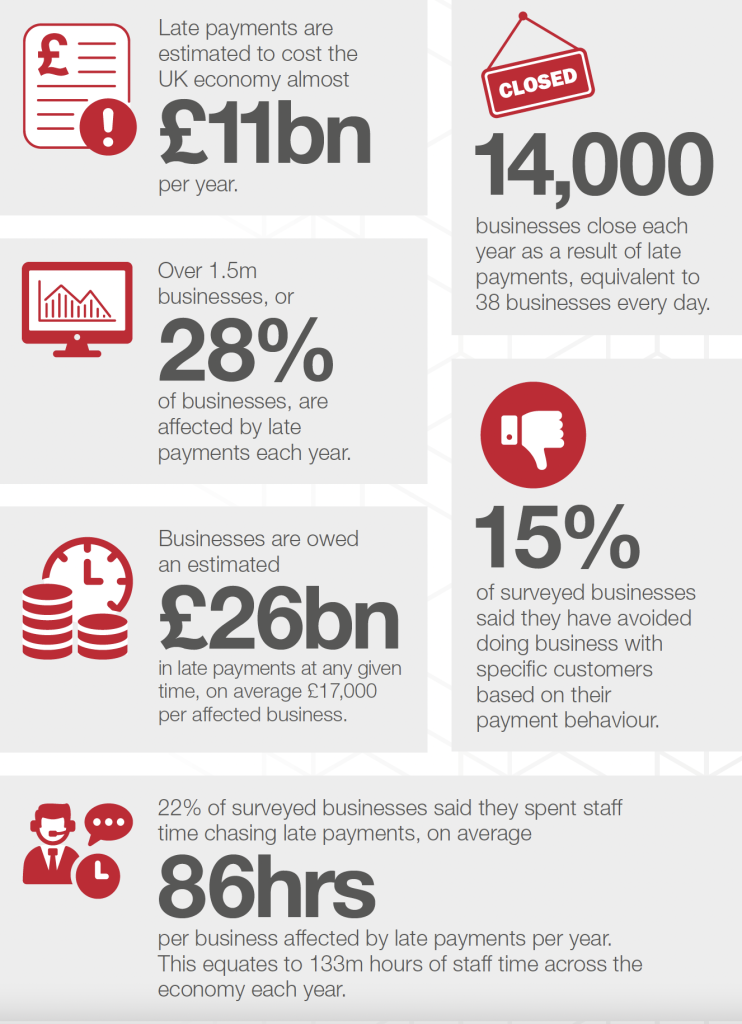
Further research from the Department for Business and Trade also found that late payments affect around 1.5 million UK businesses each year and cost the wider economy almost £11 billion annually. Additionally, 15% of UK businesses had chosen not to do business with specific customers because of their payment behaviour. Where smaller pools of suppliers are concerned, businesses can’t afford payment issues to put valuable commercial relationships at risk, unless they want to make life harder for themselves.
What may be manageable when dealing with one overseas supplier can become considerably more complicated when multiple currencies, payment routes and trading relationships are involved. For smaller teams already managing multiple parts of the business, keeping track of these moving parts can quickly become a job in itself, particularly when international payments require additional time and administration.
With fewer suppliers to fall back on, a payment problem can also have a greater knock-on effect where a key supplier is integral to day-to-day operations, potentially putting the relationship, future supply and ultimately the business itself at risk.
Source: DBT (2025) – Estimating the total economic cost of late payments and their impact on the UK economy
What should the future of payments look like?
For smaller businesses specifically, the way forward is recognising that international transfers no longer need to be watched like a hawk. Research commissioned by the Department for Business and Trade and the Office of the Small Business Commissioner found that 22% of surveyed businesses spent staff time chasing late payments, with affected businesses losing an average of 86 hours a year to the task. Across the UK economy, that amounts to 133 million hours of staff time. That is a remarkable amount of time and resources lost checking that the money has done what it is supposed to do.
Despite the lag in progress, removing this burden is not an abstract or distant reality. Innovative payment systems can already remove much of the manual work. If more SMEs can recognise that this kind of infrastructure is neither reserved for larger businesses nor an out-of-reach technological ideal, they will be better placed to expand internationally without taking unnecessary admin or hidden costs with them.
The businesses best positioned to develop will be those that think beyond their immediate payment needs. A setup that works well when international payments are occasional may function quite differently once a business is dealing with multiple currencies, suppliers and markets.
Get the payment process wrong and the consequences can extend beyond the internal finance team, putting supplier relationships under strain and potentially making a deal less commercially viable. Businesses should therefore consider not only what a payment system can do today, but whether it can accommodate greater volumes and more complex requirements as the business grows. There is little point finding a system that works perfectly, only to outgrow it just as international trade starts to take off.
As international activity grows, there should be more choice around payments, rather than leaving timing, currency and costs to chance.
Technology now allows businesses to hold and pay in multiple currencies, access competitive FX rates, integrate with accounting systems, and schedule and track everything in one place, because when it comes to payments, “fingers crossed” isn’t much of a strategy.
Making international trade work
There will always be plenty for businesses to keep an eye on when they trade across borders, from political developments to currency markets and supply chains, so wondering whether a payment has actually arrived doesn’t really need to join the list. What businesses can do is make sure the payment process provides a solid foundation for international trade.
The real measure of progress, then, is not how many features a payment system can offer, but how much more effectively a business can operate because those features exist. International trade is already becoming more connected; payments should be doing the same.
In a world where uncertainty has become the norm, taking control of payments is one small way businesses can wrestle back a little certainty from the chaos, and have one less thing to worry about.