

Many financial institutions continue to hold significant pools of idle liquidity. Why has this remained such a persistent industry problem and how does Finteum seek to solve it?
The idle liquidity that Finteum focuses on specifically is only idle for a few hours. It is intraday liquidity, which institutions have not had the opportunity to generate any return on, until now. Finteum enables banks to lend idle intraday liquidity to their counterparties as a price maker in an intraday FX swap, earning up to several million per year.
For the counterparty, this also helps to optimise liquidity. For Goldman Sachs, UBS and NatWest, which are live with Finteum, liquidity optimisation is important. When the counterparty can source intraday liquidity for the hours that it’s needed, instead of holding expensive liquidity buffers, they can generate substantial P&L.
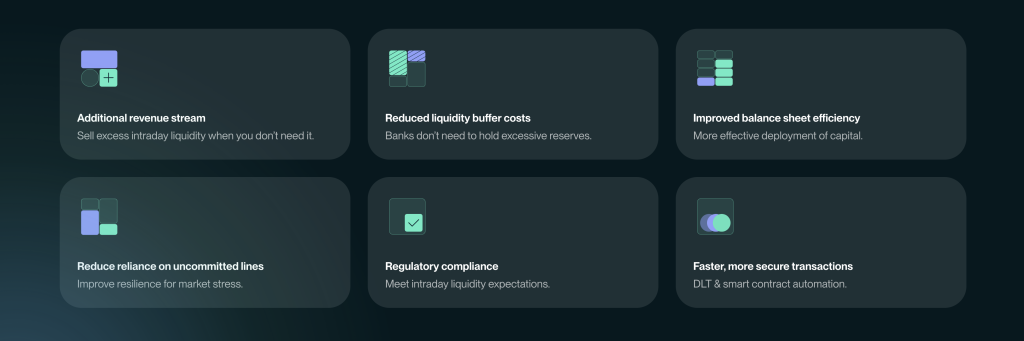
For a top-50 bank, we have calculated the P&L benefit at an average of $55m per year, from sourcing intraday liquidity and reducing liquidity buffers. This is a direct P&L benefit because the liquidity buffer held for intraday is in government bonds yielding ±4%, lower than the bank’s cost of funding at ±4.5%. By reducing the liquidity buffer the bank needs to hold, there is a direct cost saving of $55m, as well as the opportunity cost of redeploying balance sheet into higher-yielding assets.
Tier 1 banks could be on both sides of these trades, in some of their currencies, at different times of the day. For many banks, the P&L beneficiaries are the FX or STIR desks, which get lower internal charges and lower FTP from treasury.
I worked in UBS and Bank of Ireland since 2008 in treasury and on the trading floor, and I experienced first-hand the frustration of losing money on intraday liquidity every day.
In banks, persistent idle liquidity is mostly the result of inadequate solutions. But now, thanks to collaboration with our brilliant clients, together with the innovative technology and rule book that Finteum created, we are delighted to be helping the industry to become more efficient.
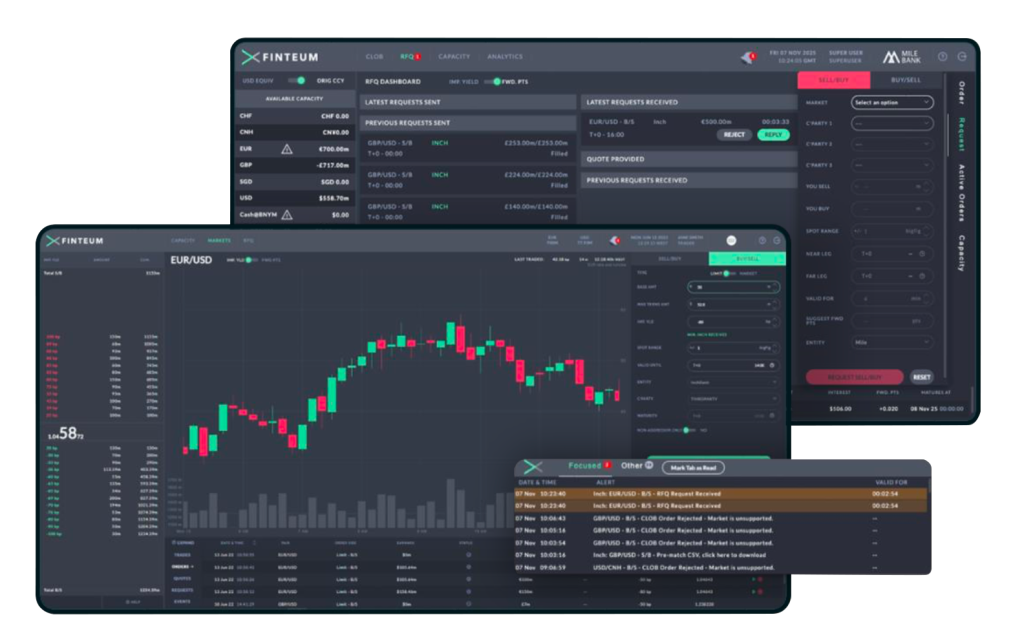
How does your platform enable banks and financial institutions to optimise intraday and overnight liquidity more efficiently than traditional approaches?
For intraday liquidity, the most common traditional approach for a bank to optimise it is to withhold outgoing payments, commonly referred to as “throttling” or “queue reordering”. Throttling creates a suboptimal bank customer experience, because corporate treasurers don’t like their payments being delayed. Also, a lot of activity, such as CLS pay-ins, can’t be withheld because it’s time-sensitive.
Finteum creates an alternative to throttling, by enabling banks to source intraday liquidity exactly when it’s needed, meaning they can continue their payments on schedule and keep clients happy, but they need to hold smaller liquidity buffers.
For overnight liquidity, Finteum plans to arrange overnight FX swaps that settle PvP at the T+0 near leg, at a chosen specific time. This will be an important risk reduction compared with traditional overnight FX swaps, where the near leg can settle any time on T+0, and where there is no PvP settlement available.
Finteum’s approach removes the settlement risk and significantly reduce the RWAs associated with overnight FX swaps, making them a viable alternative to tom/next FX swaps and to overnight repo.
The Finteum Platform offers both RFQ, for customised near leg and far leg times and disclosed trading, as well as a CLOB with a hard match, to create market liquidity around standardised far leg times, with pre-trade anonymity.
Our platform covers both FX swaps and repo, enabling banks to efficiently fund themselves intraday and overnight across both markets.
What are the key benefits institutions can achieve from adopting Finteum’s marketplace model for short-term funding and liquidity management?
As mentioned previously, the main benefit is the $55m+ business case. But there are also several important wider strategic benefits to mention.
Many banks are planning for more of their payment, settlement and customer activity moving to real-time, 24-hours, across multiple settlement methods (central banks, nostros, tokenised deposits, stablecoins, etc.). They recognise the need for inter-dealer funding via FX swaps for that new environment, and several have onboarded Finteum to support that.
All banks are getting more involved in DLT, tokenisation and digital assets. Most of these initiatives will have consequences for the bank’s liquidity. Finteum provides capabilities to reduce the impact of this, which is foundational for the banks.
In some cases, working with Finteum can meet firm-wide innovation objectives and the FX and STIR desks gain senior recognition by taking a leading role.
Banks tell us that they view Finteum as useful for both BAU and stress scenarios. Having access to an additional tool to actively manage intraday liquidity is well received by risk teams and regulators. For large EU banks, as an example, Finteum Platform trades have been helpful to demonstrate progress in addressing the 2024 ECB guidelines on intraday liquidity.
In some cases, intraday FX swaps help to facilitate and fund bank customer activity, such as larger-than-normal CLS pay-ins, IPOs and debt syndications that would otherwise be a drag on the firm’s intraday liquidity on those days.
Lastly, some banks can replace more expensive or less reliable funding, such as credit lines, with our time-specific, regulated and proven intraday FX swaps.
Finteum’s platform uses distributed ledger technology (DLT). What advantages does that have?
By leveraging DLT, the Finteum Platform creates a shared data record of each negotiation and each trade, which is only visible to the bank and its counterparty. This gets digitally signed by both sides to be ISDA compliant. This shared data record and digital workflow eliminates the need for MT300 confirmation messages. This makes the end-to-end trade workflow more efficient than with legacy platforms and enables trades to settle more quickly, which is critically important when it comes to intraday liquidity.
DLT has also made it easier for Finteum to integrate with digital settlement methods and other DLT-based solutions, such as the Fnality payment system, tokenised deposits, and Circle’s stablecoins.
Finteum has also built a validator on the Canton network, to make it easier to negotiate trades with Finteum and interoperate with Canton-based settlement solutions. Finteum is agnostic to different settlement methods, including the traditional RTGS such as Fedwire and CHAPS, but these new DLT-based methods are important to banks as they enable 24/7, real-time PvP settlement.
In what ways are liquidity optimisation, funding efficiency and settlement risk becoming increasingly interconnected challenges for participants in the global FX market and how have you gone about future proofing your platform to ensure that clients are ready for the needs of tomorrow?
The banks that onboard Finteum involve the teams from treasury, operations, digital assets, risk, compliance, etc., as well as the FX desk, to assess the Finteum Platform with their own specialist expertise. Those teams validate that all of these mentioned interconnected challenges are addressed by the Finteum Platform.
We have future-proofed our platform in several ways, beyond using the latest DLT technology.
Firstly, by ensuring our APIs are ready for electronic trading of FX swaps.
Secondly, we are making it seamless for our clients to settle 24-hours a day across central banks, nostros, tokenised deposits and stablecoins, to recycle the bank’s money in each currency more frequently and serve its clients more effectively, while maintaining settlement efficiency that is comparable to CLS today.
Thirdly, we partner with best-in-class
solutions, like United Fintech’s CobaltFX Dynamic Credit product for risk limits,
Last, but not least, we have started to develop MCP servers, in case our clients want their AI models to interact with our platform directly.