- Data analytics and Transaction Cost Analysis (TCA) have become fundamental to the FX market.
- Analytics are currently used in pre- and post-trade, informing better decision making.
- The adoption of AI enables technologically advanced firms to easily capture and analyse more data from more counterparties and markets – giving them an information and workflow advantage.
LSEG FX recently published the second research report in a two-part series, FX Priorities for 2025 By examining the focus areas cited by FX trading firms, this research allows market participants to benchmark themselves against broader market trends and identify solutions available to drive growth and remain competitive.
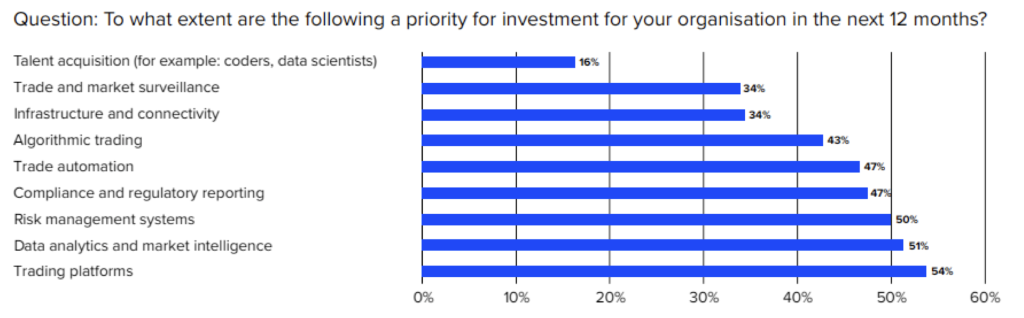
A key priority identified in the report is the importance of data analytics. Of the 400 FX professionals surveyed around the world, over half are prioritising and investing in this area. (see chart below)
Beyond the quote: a new era of FX transparency
Proving best execution is more than just receiving five quotes in competition and trading on the best price. It has driven firms to look at the total cost of a trade, and TCA is now widely used in the FX industry by all types of firms.
This growing reliance on TCA is reshaping how firms evaluate execution quality and continues to evolve, as observed by Alex Goraieb, Head of FX Data, Analytics and Pre-trade Workflows at LSEG FX: “There is a lot of talk about TCA at the moment, which needs very good data to drive the analytics. It almost feels that now there’s, an emergence of new providers in this space that allow a lot more transparency across the liquidity available and how you can engage with that liquidity.”
The advantage of trusted data and algos
The availability of more FX data and better technology has driven the use of trading algorithms, which enable firms to trade more efficiently and split FX trades into smaller sizes to reduce footprint.

However, the availability of services which analyse the performance of algos is driving adoption. Alex Goraieb said: “The data doesn’t lie. The analytics will show the path, and so either it will tell them the algo is not quite delivering what it promised, or that the algos are delivering a better performance over what they used to do.”
The integration of analytics into pre-trade workflows is also transforming algo selection and usage. Romael Karam, Director of Hedge Fund Strategy at LSEG FX expanded on this: “In post-trade you can look at how algos have performed, and you can look at that against a whole range of different parameters and different benchmarks. But the really powerful piece is the pre-trade solution that we have delivered in Workspace, with our partners, Tradefeedr. Clients can review and ascertain exactly which algo or group of algos they should be considering, for different market environments. Using this service clients can even analyse whether or not they should use an algo for specific currencies or market conditions. Ultimately it gives clients the confidence to use algos more actively.”
Alex Goraieb commented on how different firms are using the data analytics: “I’ve had a lot of conversations with large corporates and asset managers around this topic, and in many cases it’s about transparency and clients understanding the models before they commit to using them. In the past you only found out how good a model was when you’ve actually used it repeatedly and you looked at the outcomes. So having a strong suite of analytics and data that has learned from the experience of everybody that’s gone before is beneficial. This means that you can determine which is the best way to mitigate the risk on the trade for any particular circumstance.”
The next frontier for AI in FX trading
With FX trading firms focusing on innovation and investing in next gen solutions, the market will continue to evolve and incorporate the use of AI to inform better decision making.
A good example of this is in the pricing of FX Swaps, where firms are capturing data from multiple sources to help them build more accurate curves. This includes data relating to FX Swaps and Forwards, FX Spot, STIR Futures, OIS, IRS and Cross-Currency Basis Swaps. In the past it would not be possible to capture and analyse all of these data sources, but as technology and AI have advanced, a small but growing number of firms are analysing all of this data in real-time to give them an information advantage.

Now that we have pre- and post-trade analytics, the next likely step is to use data analytics during a trade. Bart Joris, Head of Sell-side Trading at LSEG commented, “We are very well acquainted in the market with analytics and TCA. These days we are using TCA in pre- and post-trade. What is the next real evolution? What you’re going to have is at-trade TCA. When you do your execution, you will be able to use analytics to see in real-time how the trade is progressing and to stay informed in case you need to change your execution strategy.”
The quotes in this article are from an interview conducted in July 2025.
To request a copy of the second edition of LSEG’s global FX research please scan the QR code.